Sunday, April 27, 2014
TOW #25 Here's Why Facebook Is Making You Download Its Messenger App by Kia Makarechi
Reading Goal: Read an intelligent piece that is relevant to my daily life.
Writing Goals: Create a clear thesis statement and effectively analyze evidence.
We’ve all been there. You log onto Facebook, go to your messages, and a notification screen appears. “Download messenger. This person, this person, and this many of your friends are already using it.” The constant pressure from Facebook to download messenger can be annoying. Through it’s use of statistical data and quotes from important figures in the Facebook world, this article serves to explain the reasoning behind Facebook’s big move and to predict where they may go in the future.
Facebook is, at its core, a business and therefore it must make money; this article uses statistics to show the economic motive that Facebook has behind all of their moves. “Currently, Facebook (including Instagram) accounts for 17 percent of time spent on all connected iOS and Android devices...” (par. 5) so it already has a huge presence in the mobile world. As a mobile super power, Facebook has the capability to dominate its market and maximize profits. Adding more apps and gadgets to its mobile presence only adds more outlets of profit for the company, whose profits exceed billions of dollars per quarter year. These statistics simply prove that Facebook has an incredible presence in the technology world, only to be strengthened by the addition of newer apps. Facebook, in making these decisions, must think of what the company is, and how they can proceed. This article uses quotes from important individuals within Facebook to represent the company and explain why mobile apps are the right direction (or at least, the direction that Facebook is going in, no matter what). The article quotes Zuckerberg in paragraph 5, stating, “There is no argument. Facebook is a mobile company.” Since this is true, it makes logical sense that they would continue on a path of mobile development. These statements justify the actions of the company, both present and future. Using quotes allows insight into the mind of Facebook, giving readers (and Facebook users) a reason for these pushy developments. Running a major company comes with massive perks for sure, but also massive responsibility. Facebook must keep its reputation as a leading mobile entertainer while creating new ideas for profit and status. This article, using both statistics and quotes from Facebook leaders, provides rationale and analysis to users. This way, the next time that they are pressured to use a new Facebook app, they understand WHY.
http://www.vanityfair.com/online/daily/2014/04/why-facebook-is-making-you-download-its-messenger-app.print

Wednesday, April 23, 2014
TOW #24 From Private Ordeal to National Fight: The Case Of Terri Schiavo By: Clyde Haberman
The moral battle over the issue of continued life support for a loved one is a difficult struggle for all those involved. It puts a strain on everyone and the relationships that they have. This was readily apparent in the case of Terri Schiavo. This article used rhetorical questions and factual evidence to express the horrible situation that Schiavo’s loved ones were in, and how her legacy affected the world.
Through the use of rhetorical questions, the author expresses the emotional roller coaster that Schiavo’s family faced. This topic easily strikes a cord in anyone who has been in a similar situation, but it may be harder to reach those who haven’t. Rhetorical questions such as, “What, if anything, is the enduring legacy of this painful episode?” and “What qualifies as death with dignity?”(Haberman) allow readers to put deeper thought into the topic. Especially in the last question, readers are pushed toward thinking of their own definition of “death by dignity” and how it may conflict with other peoples. They act as thought catalysts for readers. After they won’t be outside bystanders, the readers will be invested in the subject. The rhetorical questions allow the readers to understand the complexity of the situation and understand better the tragic story of Terri Schiavo.
In any legal analysis piece, there are data and facts that support the technical side. The technical information adds to the legal and emotional side of the article, and it therefore encompasses an entire argument. The author states, “Larger questions remain, affecting an estimated 25,000 Americans deemed by doctors to be in a vegetative state” which shows that many people are in a similar situation, just less in the public eye. The author makes his points more reasonable by allowing readers to infer that this is not the only case, and that this wasn’t his main point.
Terri Schiavo’s family and husband were faced with a difficult decision. It took strength and courage from all to face the media backlash that they all were privy to. This article serves to commemorate Terri and too give a nod to her loved ones for staying strong in this difficult time.
Sunday, April 20, 2014
IRB INTRO WILD BY CHERYL STRAYED
Wow, I can’t believe this is already my last I-R-B intro post. Seems like it was just yesterday that I picked up All The President’s Men. Well, time to move on I guess. I think for this marking period, I am going to try a memoir. I keep hearing about this book, “Wild” by Cheryl Strayed so I finally decided to do it. Also, they’re making a movie of it with Reese Witherspoon, so I felt I had to read it before the movie comes out. Wild is a memoir about Strayed’s journey of more than a thousand miles of the Pacific Crest Trail (and some other places). Hopefully, this book will depict the lessons that she learned in her journey and I can take them and apply them to my life. I hope to gain knowledge on a more spiritual level from this book, as opposed to the more technical information that I got from the other books I read this year. Here goes nothing....

Sunday, March 30, 2014
TOW #23 Doing School by Denise Clark Pope
I’ll be honest... when I first started reading “Doing School-How We Are Creating a Generation of Stressed Out, Materialistic, and Miseducated Students,” I didn’t think it would catch my attention. After all, how could it possibly with such a long title? And yet, as I find more and more often today, I was proven wrong. Again. This book was entertaining and funny but also serious and informative. Most of all, and what appealed to me most from it, was that it was so relatable to me. As a high school student going through the exact education system and experience that this book discussed, it took on a whole new level for me. It wasn’t simply talking about an intangible idea, suddenly this book was taking a look inside the four walls of my high school (theoretically speaking, because we have more than four). Therefore, I really appreciated this book and got a better understanding of what it really meant to say.
This book could probably be interpreted in several different ways based on it’s audience at the time. However, I don’t think it could ever not be understood at all. The main point is right there in the title. “Schools are doing x,y, and z, and I’m going to show you how...” is what it seems to say. Through the use of extensive examples, the book does indeed show the “how” behind the problem. In addition, Denise Clark Pope uses clear wording and simple diction to get her point across. She doesn’t cloud her meaning with pretentious diction or imply that she is more intelligent than her readers. She recognizes that the people reading the book are the ones who can make a difference, and are very therefore important. She treats them as equals and her attitude shows through in her writing. I really, really, liked this book.
Sunday, March 23, 2014
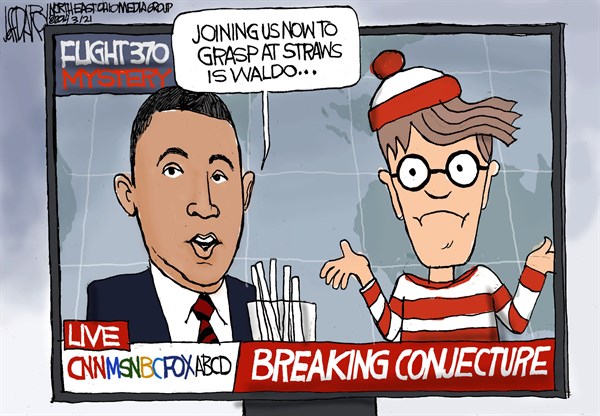
TOW #22 A Visual Text: The Malaysian Plane is STILL MISSING.
As you probably know, or well, let’s be honest, you DO know, (unless you’ve been living on a stranded island for 7 years, but I bet even that lady knows now) that the plane from Malaysian Airlines, flight number 370 has gone missing. The plane seems to have vanished from the Earth. Countries all over the world are looking for it in what seems to be a hopeless search. Where could it possibly be? That’s the question on everyone’s minds. This political cartoon from Jeff Darcy-who has made several on the subject over the past couple of weeks- reflects the baffled attitude that the common public shares.
While this is a political cartoon, Darcy recognizes that this may be a touchy subject. therefore, the cartoon is not overtly funny. In fact, like most political cartoons, it is professional and lightly humored. In order to reflect the fact that confusion is shared by everyone, the news channel reporting in the picture is “CNNMSNBCFOXABCD” which is funny, but also serious. Nobody really knows what is going on. In fact, as Darcy points out, it’s like a search from the popular series, “Where’s Waldo?” There doesn’t seem go be an answer, much like in the Waldo books. In order to display the incredible difficulty that all search parties are going through, Darcy depicts Waldo in the picture. Waldo looks as baffled as everyone feels. In showing Waldo, Darcy implies many things that central around the theme. He implies that even Waldo is easier to find than the plane and that Waldo, who is arguably the hardest person to find (if he was real), is confused. Both of these ideas add to the air of mass confusion that everyone is facing, but do so in a respectful and not overly obnoxious way. We can only hope, as Darcy seems to, for the best.
Sunday, March 16, 2014
TOW #21 The Age Of Individualism by Ross Douthat
What was most interesting about this article was not the idea that it presented (which was indeed very thought provoking) but was instead it’s ending. Judging from the opinions presented in the article, I was in the mind set that there would be a definitive endpoint. Yet, the article didn’t serve as one. It was more of a “probably” sort of thing which seemed a little out of place with the rest of the article. Besides the ending, however, this article by Ross Douthat in the New York Times (appropriately titled, The Age of Individualism) provides both analysis of the current societal trends and political behaviors (of the younger mindset) and a glance as to what is in store for the future.
This article discusses the “millennials” (a category that I fall into, from what I gather) and their trends in political views. Even though the millennials are turning to different views collectively, these views now represent a growing individualism within each single member. This was a little difficult to understand at first but, as the article says, “It (individualism) explains both the personal optimism and the social mistrust, the passion about causes like gay marriage and the declining interest in collective-action crusades like environmentalism, even the fact that religious affiliation has declined but personal belief is still widespread” (par. 4) Individualism means not that the people of the new generation all think differently, but that they think for themselves most of all. The article then presented an interesting idea (one that relates to an earlier point in my latest essay, that history repeats itself.)
“The advance of individualism thus eventually produced its own antithesis — conformism, submission and control” (par. 9) This idea was what intrigued me so much about the article. Articles on individualism are abundant these days (after all, it is “The Age of Individualism”) but nobody really ever stops to think about what happens next. According to this article, the future holds a collectivism to it that can only be inspired by the technological age. I thought this was an interesting direction, and it certainly made the article more interesting. I can’t wait to see how it all plays out.
This article discusses the “millennials” (a category that I fall into, from what I gather) and their trends in political views. Even though the millennials are turning to different views collectively, these views now represent a growing individualism within each single member. This was a little difficult to understand at first but, as the article says, “It (individualism) explains both the personal optimism and the social mistrust, the passion about causes like gay marriage and the declining interest in collective-action crusades like environmentalism, even the fact that religious affiliation has declined but personal belief is still widespread” (par. 4) Individualism means not that the people of the new generation all think differently, but that they think for themselves most of all. The article then presented an interesting idea (one that relates to an earlier point in my latest essay, that history repeats itself.)
“The advance of individualism thus eventually produced its own antithesis — conformism, submission and control” (par. 9) This idea was what intrigued me so much about the article. Articles on individualism are abundant these days (after all, it is “The Age of Individualism”) but nobody really ever stops to think about what happens next. According to this article, the future holds a collectivism to it that can only be inspired by the technological age. I thought this was an interesting direction, and it certainly made the article more interesting. I can’t wait to see how it all plays out.
Sunday, March 2, 2014
TOW #20 Doing School by Denise Clark Pope
The students of today spend their time panicking, procrastinating, and pressured, (the three P’s, if you will). The main question that Denise Clark Pope tries to answer, is “why?”. Why are students so inclined to cheat and lie their way through, only to find that they don’t understand the material? Why are they spending their time complaining about it rather than being proactive? Why are they so stressed in the frist place. Pope’s book, “Doing School: How We are Creating a Generation of Stressed Out, Materialistic and Miseducated Students” serves to answer these questions, and provide some explanation for the stressed out student generation.
Although most likely directed at a teacher driven audience, the book is versatile in that it can appeal to anyone. Who doesn’t love a good explanation? This book can appeal to students,parents, even grandparents. This is due, in part, to the use of relatable language. In addition, the use of examples is also at play.
Real life examples allow a deeper understanding of both the school systems and their effect on the students.The book starts off with one example from Faircrest High, discussing several teachers idea of the perfect student. One teacher even claimed that if she had a son, she would want him to be just like one of her students. All of these students had incredibly high grades, were well rounded, and involved in ridiculous amounts of extra-curricular activities. These students are doing the same thing as hundreds of thousands of students all over the country, and most likely worldwide. However, these students are an exception. Most students find themselves doing these same things because they are feeling pressure to compete with these “exceptional” students. This causes unimaginable stress for the students, who as the book quotes, “ go to get good grades which brings them to college, which brings them high paying jobs, which brings them happiness.” The various examples in the book serve to show the stress that students feel to succeed. It feels as if their whole life is riding on their high school career.
This book allows personal insight that is invaluable to everyone. It shows the flaws in our current school system and provides insight for improving it. In addition, it lets people know that they aren’t alone, many other people are struggling and stressed. It’s a call for understanding at heart.
Subscribe to:
Posts (Atom)