Sunday, March 23, 2014

TOW #22 A Visual Text: The Malaysian Plane is STILL MISSING.


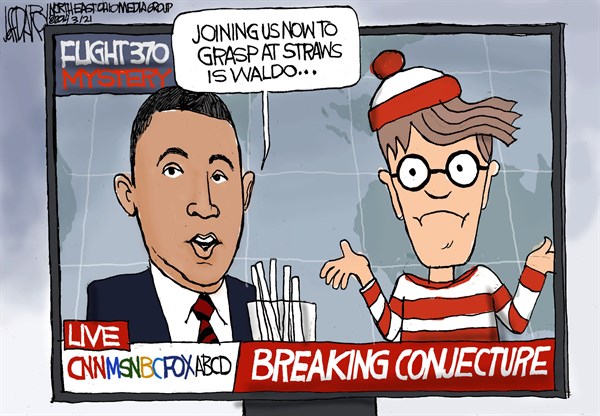
As you probably know, or well, let’s be honest, you DO know, (unless you’ve been living on a stranded island for 7 years, but I bet even that lady knows now) that the plane from  Malaysian Airlines, flight number 370 has gone missing. The plane seems to have vanished from the Earth. Countries all over the world are looking for it in what seems to be a hopeless search. Where could it possibly be? That’s the question on everyone’s minds. This political cartoon from Jeff Darcy-who has made several on the subject over the past couple of weeks- reflects the baffled attitude that the common public shares.

While this is a political cartoon, Darcy recognizes that this may be a touchy subject. therefore, the cartoon is not overtly funny. In fact, like most political cartoons, it is professional and lightly humored. In order to reflect the fact that confusion is shared by everyone, the news channel reporting in the picture is “CNNMSNBCFOXABCD” which is funny, but also serious. Nobody really knows what is going on. In fact, as Darcy points out, it’s like a search from the popular series, “Where’s Waldo?” There doesn’t seem go be an answer, much like in the Waldo books. In order to display the incredible difficulty that all search parties are going through, Darcy depicts Waldo in the picture. Waldo looks as baffled as everyone feels. In showing Waldo, Darcy implies many things that central around the theme. He implies that even Waldo is easier to find than the plane and that Waldo, who is arguably the hardest person to find (if he was real), is confused. Both of these ideas add to the air of mass confusion that everyone is facing, but do so in a respectful and not overly obnoxious way. We can only hope, as Darcy seems to, for the best.


Sunday, March 16, 2014

TOW #21 The Age Of Individualism by Ross Douthat

What was most interesting about this article was not the idea that it presented (which was indeed very thought provoking) but was instead it’s ending. Judging from the opinions presented in the article, I was in the mind set that there would be a definitive endpoint. Yet, the article didn’t serve as one. It was more of a “probably” sort of thing which seemed a little out of place with the rest of the article. Besides the ending, however, this article by Ross Douthat in the New York Times (appropriately titled, The Age of Individualism) provides both analysis of the current societal trends and political behaviors (of the younger mindset) and a glance as to what is in store for the future.

This article discusses the “millennials” (a category that I fall into, from what I gather) and their trends in political views. Even though the millennials are turning to different views collectively, these views now represent a growing individualism within each single member. This was a little difficult to understand at first but, as the article says, “It (individualism) explains both the personal optimism and the social mistrust, the passion about causes like gay marriage and the declining interest in collective-action crusades like environmentalism, even the fact that religious affiliation has declined but personal belief is still widespread” (par. 4) Individualism means not that the people of the new generation all think differently, but that they think for themselves most of all. The article then presented an interesting idea (one that relates to an earlier point in my latest essay, that history repeats itself.)

“The advance of individualism thus eventually produced its own antithesis — conformism, submission and control” (par. 9) This idea was what intrigued me so much about the article. Articles on individualism are abundant these days (after all, it is “The Age of Individualism”) but nobody really ever stops to think about what happens next. According to this article, the future holds a collectivism to it that can only be inspired by the technological age. I thought this was an interesting direction, and it certainly made the article more interesting. I can’t wait to see how it all plays out.

Sunday, March 2, 2014

TOW #20 Doing School by Denise Clark Pope


The students of today spend their time panicking, procrastinating, and pressured, (the three P’s, if you will). The main question that Denise Clark Pope tries to answer, is “why?”. Why are students so inclined to cheat and lie their way through, only to find that they don’t understand the material? Why are they spending their time complaining about it rather than being proactive? Why are they so stressed in the frist place. Pope’s book, “Doing School: How We are Creating a Generation of Stressed Out, Materialistic and Miseducated Students” serves to answer these questions, and provide some explanation for the stressed out student generation.

Although most likely directed at a teacher driven audience, the book is versatile in that it can appeal to anyone. Who doesn’t love a good explanation? This book can appeal to students,parents, even grandparents. This is due, in part, to the use of relatable language. In addition, the use of examples is also at play. 

Real life examples allow a deeper understanding of both the school systems and their effect on the students.The book starts off with one example from Faircrest High, discussing several teachers idea of the perfect student. One teacher even claimed that if she had a son, she would want him to be just like one of her students. All of these students had incredibly high grades, were well rounded, and involved in ridiculous amounts of extra-curricular activities. These students are doing the same thing as hundreds of thousands of students all over the country, and most likely worldwide. However, these students are an exception. Most students find themselves doing these same things because they are feeling pressure to compete with these “exceptional” students. This causes unimaginable stress for the students, who as the book quotes, “ go to get good grades which brings them to college, which brings them high paying jobs, which brings them happiness.” The various examples in the book serve to show the stress that students feel to succeed. It feels as if their whole life is riding on their high school career. 

This book allows personal insight that is invaluable to everyone. It shows the flaws in our current school system and provides insight for improving it. In addition, it lets people know that they aren’t alone, many other people are struggling and stressed. It’s a call for understanding at heart.

Sunday, February 23, 2014

TOW #19 The Anti-Economist: The Digital Revolution That Wasn't by Jeff Madrick from Harpers Magazine (Jan 2014)


Reading goals: For this TOW, I want to read a serious article. I find myself reading fluffier type pieces so for this one I want to read a more professional type piece from a respected source.

Writing Goals: In this TOW, I want to have control over my language. I want it to flow nicely and effectively express my meaning while keeping within the word limit. I also want to have a strong thesis that supports my claim.


Technology is a double-edged sword. It can help and hurt the economy and the citizens. In “The Anti-Economist,” Jeff Madrick uses historical exemplification and factual evidence to create professional and analytical insight into why modern inventions have failed.

To provide insight into how new technologies fail to reach potential, Madrick must establish what this potential is through the use of historical evidence. Madrick uses examples to reflect the general attitude toward machines. He mentions the Luddites, saying that they are “only the most famous example of workers who fought the labor force.” (par.4). In using “only,” Madrick shows that there have been several different times where this has occurred, that opposition is constant. Other examples show technology’s effect on society. He mentions, “in the 1950’s and 60’s, productivity and wages rose unusually rapidly, and unemployment remained low.” (par. 4) In using similar examples, the author is able to create a sense of pattern and expectation for technology. He says, “increasing prosperity has been the norm” (par.4) with the addition of new technologies previously. Later, he presents the technologies of modern times. From precedent, it can be assumed that, as in the past, “some jobs are eliminated, but more and better paying jobs often replace them.” (par. 11) Madrick, after establishing potential, proves the failure of new technologies, using statistics as a tool.

Having established precedent for technology’s benefit to society, Madrick expresses the lack of benefit of new technology with statistics. First, he presents statistics about expectations for modern technology. He quotes Businessweek, “we’re talking about 3-4% growth,” (par.6) in terms of the computers effect on prosperity in the job market. This continues to build the idea that technology is prosperity. As further statistics show, modern technology falls short of this expectation. Madrick explains that productivity has increased, whereas employment decreased. He presents employment rates from major companies in 1955 compared to rates of major companies today, which are much lower. (par.9) Utilizing statistics, Madrick highlights the lack of benefit that citizens are receiving from technology, falling short of expectations. 

Through his use of statistics and historical evidence, Madrick sets precedent for technology to succeed. He also shows that modern technology fails to live up to these expectations, and the only choice we have is to hope for the next big revolution.

Monday, February 10, 2014

TOW #18 How A Math Genius Hacked Okay Cupid by Kevin Poulsen


Who doesn't like a good unconventional love story? Not the mushy, overly romantic Notebook stuff, but the messy, funny, heartfelt kind? Maybe it's just me, but I'm a sucker for the stuff, and that's exactly what this article was. A truly unconventional, unbelievable (and AMAZING) story. 

It starts with a vivid description of a man. Interestingly, the article included a picture as well, a touch that I believe highly attributes to the overall effectiveness. The picture of Chris McKinlay lets you imagine the story as a movie, and as it plays out in your head, it really does reel you in. The descriptions act as another catalyst for the minds motion picture. The text reads, “Chris McKinlay was folded into a cramped fifth-floor cubicle in UCLA’s math sciences building, lit by a single bulb and the glow from his monitor. It was 3 in the morn­ing, the optimal time to squeeze cycles out of the supercomputer in Colorado that he was using for his PhD dissertation.” One can just picture McKinlay sitting in his cramped desk, pouring over numbers and absent mindedly getting distracted by his own profile. When the idea of hacking OkCupid hits, it hits the audience as well. This process takes them through the journey, instead of viewing it, readers are now living it. The descriptions explain EVERYTHING, from the statistical data analysis process, to the types of women in each group, even the conversations that women had with McKinlay are expressed. These additional details really convery the painstaking and all-consuming work that had  been done on the project. Most importantly, they inspire hope. If a math professor with little social skill can find love, why can't you? McKinlay found the most popular questions within his target, deciphered which cluster was most popular to him, and was able to revolutionize online dating. This article provides an inside look at the mystical world of online dating, showing that if one really does try hard enough, they can find love. And isn’t that what we all really want? A chance?
READ THE STORY: http://www.wired.com/wiredscience/2014/01/how-to-hack-okcupid/all/&src=longreads

Tuesday, February 4, 2014

IRB INTRO #3 Doing School: Aka the explanation of how school makes me crazy.

For this new marking period, I will be reading Doing School by Denise Clark Pope. I decided to start reading it, mostly because when I asked Mr. Yost for a book recommendation he handed me this book, but also because it seems really interesting. The title is followed by a colon and a simple explanation. It reads, "Doing School: How We Are Creating a Generation of Stressed-Out, Materialistic, and Miseducated Students." Although I absolutely abhor this style of titling a book (there's a back cover for a REASON!) I genuinely feel that this short addition sums up the book pretty well. Or, so it seems as of now. The book is a more serious spin on nonfiction writing than I've been reading, and I am intrigued as to how it will go. I can't wait to read this book and see, as a student; how schools are influencing me. Here goes nothing... 

Sunday, February 2, 2014

TOW #17 Happy (not at all) Groundhog Day... (What a great movie!)

It's that time of the year again. February has just begun, and besides being the birth-month of some incredibly important people (namely, me and Abraham Lincoln, February 12th all the way) there are some other major yearly events too. The beginning of February means the end of football season,  and (we can only hope) the end of winter. Or at least, it’s announcement, which is promptly determined by a groundhog.  It’s an incredibly odd system that we’ve come up with. Every year we set a groundhog loose and base our weather predictions on it’s view of it’s shadow. If he sees his shadow, it’s six more weeks of winter for us all (joy...) and if he doesn’t, THE END IS NEAR. Each year, our own personal morale for the next 6 weeks is determined as PA citizens by a groundhog. This entire event is reflected in this hilarious (albeit depressing, as I am a believer in the powers of Puxsutawney Phil) political cartoon:

The image reflects the classic scene, a crowd of hopefuls decked out in excessive winter gear stand awaiting the approval of a groundhog. There are newscasters and little kids, it's not just a superstition, it's a huge spectacle. The weather in the background shows a bright sun, contrasting greatly with the snow on the ground, and yet it so accurately depicts the unlucky streak that we’ve been having all over. It’s frustratingly accurate, and humorously so, the entire thing is kind of a joke. The author of this cartoon, whether he be a believer or not, clearly understands the impact that the groundhog has. He depicts the groundhog as a self-aware little guy  who is in denial. I’m sure NOBODY wants more winter, not even him. The groundhog, covered by vast white “snow” is hanging out on a lounge chair with a Hawaiian style shirt and lemonade. While this depicts the sad reality of our holday, it also represents the hopeful society that we have. Even though we know it’s goign to be a cold, long winter, we still muster up the spirit to celebrate anyway. Happy groundhog day, I’m off to go see the movie.
http://www.politicalcartoons.com/cartoon/399d197f-52a6-4754-8158-7bcfd0b8cf60.html